
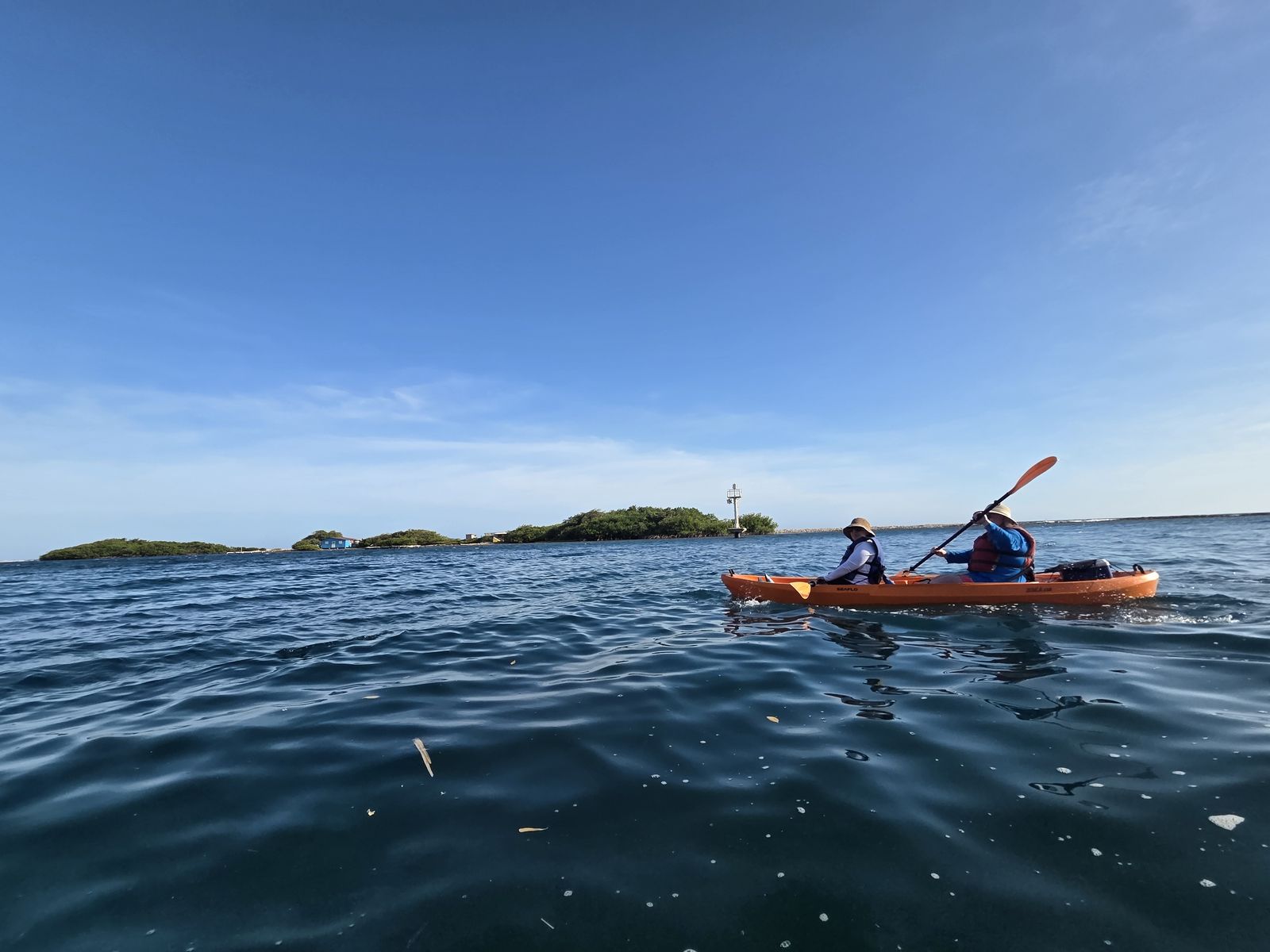
Kayak rental in Aruba: what exists and what works
 Your booking is financially protected by Trust My Travel
Looking for a kayak rental in Aruba is a sensible way to start planning, and it deserves an honest answer rather than a sales pitch. Rentals do exist here. They are just scarcer, more tied to where you sleep, and launched into livelier water than most visitors expect. What follows is what actually exists here, and why the wind matters more than the boat does. A guided kayak and snorkel tour is compared against it further down.
What kayak rental in Aruba actually looks like
Aruba has no large walk-up kayak rental counter on the south coast where you pay by the hour, pick a boat off a rack and go. What exists is smaller and scattered:
- A number of resorts on the west and southwest coast keep a few sit-on-top kayaks for their own guests, sometimes free for a short slot, sometimes bookable through the beach watersports desk.
- Some watersports desks attached to those hotel beaches will put a paddler out in front of the property, usually with a time limit and a defined area.
- A few villa, condo and Airbnb hosts include a kayak with the house, which is genuinely nice if the house sits on calm water.
All of them come with the same catches. They are tied to where you are staying, so if you are not a guest of that property the answer is often no. They keep you on the stretch of water in front of that beach, which is not where the mangrove channels, the reef edges and the low islets of the south coast are. And they hand you a boat rather than a plan: no route, no read on the day's conditions, no one beside you if the wind gets up.
If your idea of a good morning is twenty minutes of paddling in front of your hotel before breakfast, a resort kayak is a fine and easy way to get it. If you came here wanting to reach the quiet water on the other side of the island, a rented boat in front of a hotel will not get you there.
The trade winds are the real story
Aruba sits directly in the path of the northeast trade winds, and they blow across the island nearly every day of the year. They tend to be lightest at dawn and build through the late morning and afternoon, and they are at their most insistent in the spring. Anyone who grew up here plans their water time around that clock without thinking about it. Visitors usually meet the wind for the first time from inside a kayak.
In a kayak the wind is not an abstraction, it is propulsion you did not ask for. Paddle out with it behind you and the first fifteen minutes feel wonderful, faster and easier than you expected. The return leg is the one that counts: into the breeze, into a short stacked chop, in a light plastic boat that sits high and catches every gust like a sail. Add the current that runs along the south coast and squeezes between the islets, and a paddler who felt strong on the way out can find themselves working hard just to hold position on the way back.
That is the pattern behind most kayak trouble on this island. Not a violent sea. A light boat, a steady breeze blowing away from the land, and a paddler who did not know the trip was going to be measured on the way home.
What else the map does not tell you
- The bottom changes fast. Shallow reef, coral heads and sea urchins sit in water that looks uniformly turquoise from the surface. Knowing where you can step out and where you should not is local knowledge, not something you read off a phone.
- The mangrove channels look identical. Inside them the wind drops and the shade is beautiful, and every turn looks like the last one. People do get turned around in there.
- There are boats. Fishing skiffs and tour boats use the channels and cuts, and a kayak is low, quiet and hard to see against the water.
- Most of this coastline has no lifeguard. On a weekday morning, long stretches of it have nobody watching at all.
None of this makes Aruba dangerous. It makes it a place where the difference between a lovely paddle and a long, frightening one is knowing the water, and the water changes hour by hour.
What a guided tour includes
A guided kayak and snorkel tour is not a rental with someone standing nearby. Everything on the water comes with it: the kayak, the paddle, the life vest, water and fresh fruit, and snorkel gear on the Mangel Halto lagoon and reef tours. What you are really buying is the two things a rental can never include. First, a route chosen for the conditions on that specific day and that specific hour, which is why we often paddle into the wind on the way out so the way home is the easy half. Second, an honest call about whether today is a day to go at all.
Our tours leave from Savaneta on the sheltered south coast, daily at 8:30 AM, 1:00 PM, and a sunset departure at 4:30 PM. The tour itself is about 2.5 hours on the water, and if you add hotel pickup, the drive to Savaneta and back is on top of that. Adults are $89.99 and children from 6 to 12 are $69.99, with a minimum age of 6. If you would rather not drive, hotel pickup and drop off is available at $110 per vehicle round trip. Groups stay small, everyone gets a briefing before launch, and your guide paddles beside you the whole way. The crew is local, speaks English, Spanish and Papiamento, and the tour was founded by a veteran Aruban ranger with decades on this coast.
No kayak experience is needed. Most of our guests have never sat in one.
Rental versus guided, side by side
| Renting a kayak | Guided kayak and snorkel tour | |
|---|---|---|
| Availability | Limited and property tied. Mostly resort guests, some watersports desks, some villa rentals. | Daily departures at 8:30 AM, 1:00 PM, and a sunset departure at 4:30 PM, open to anyone, booked online. |
| Where you can go | The water in front of the beach you rented from, usually inside a set area and a time limit. | The sheltered south coast route: mangrove edges, clear shallows and the islets off Savaneta. |
| Reading the conditions | Yours to judge. Wind, current, tide and the return leg are all your call. | Your guide picks the launch, the line and the timing for that hour, and calls it off if the day says so. |
| Snorkeling | Gear is usually a separate rental, and you need to know which spots are worth stopping at. | On the Mangel Halto lagoon and reef tours, snorkel gear included with stops at sites the crew already knows. The Sea Glass Island route has no snorkel stop. |
| If something goes wrong | You are on your own water, often out of sight of anyone who would notice. | A guide paddles with the group, carrying safety gear and a phone, and the launch is minutes away. |
| Getting there | Whatever beach you can reach from your hotel. | Savaneta on the south coast. Drive yourself, or add pickup and drop off at $110 per vehicle round trip. |
| What it costs | Varies by property, often bundled into a stay or a watersports desk rate. Confirm locally. | $89.99 adult, $69.99 child 6 to 12. Kayak, gear, guide, water and fruit included. Free cancellation up to 24 hours before. |
If you would still rather paddle on your own
Some people simply want their own boat and their own quiet, and that is fair. If that is you, a few things worth knowing from people who paddle here every day:
- Go early. The water between sunrise and mid morning is the calmest you will find, and the wind builds from there.
- Paddle into the wind first. The leg that beats people is the one home, so spend your fresh arms on the hard half.
- Stay close to shore and inside the lee of the land. The south coast is sheltered for a reason, and the open stretches are not.
- Wear the life vest, keep water and sun cover with you, and take a phone in a waterproof pouch.
- Tell someone where you are going and when you expect to be back.
- If you can see whitecaps from the beach, choose a different morning. The sea will still be there tomorrow.
Where to next
Full pricing and what is included lives on what a kayak tour costs in Aruba. If you are wondering about the water itself, read do you need to swim to kayak here and our weather and wind policy. Packing questions are answered on what to bring. To see the routes, start with Sea Glass Island or the Mangel Halto kayak and snorkeling tour, or browse all Aruba kayak tours. The village we launch from is Savaneta.
Questions guests ask
Can I rent a kayak in Aruba?
In a limited way, yes. Several resorts and beach watersports desks keep a few sit-on-top kayaks for their own guests, and some villa and condo rentals include one with the property. What Aruba does not have is a large standalone rental counter on the south coast that anyone can drive up to. A rental also keeps you on the stretch of water in front of the beach you rented from, which is rarely where the mangroves, the reef and the islets are.
Is it safe to kayak alone in Aruba?
It depends entirely on the wind, the hour and the coast. The northeast trade winds blow across Aruba almost every day and usually build through the morning, so a paddle that felt easy going out can be hard work coming back into the breeze and chop. Most shorelines have no lifeguard. If you do go out on your own, go early, stay close to shore, wear the life vest and tell someone your plan.
What does a guided kayak tour include that a rental does not?
The kayak, paddle, life vest, water and fruit are all included, plus snorkel gear on the Mangel Halto lagoon and reef tours, along with a guide who reads the wind and current and picks the route for that day and hour. Tours leave daily from Savaneta at 8:30 AM, 1:00 PM, and a sunset departure at 4:30 PM, with about 2.5 hours on the water. Adults are $89.99 and children from 6 to 12 are $69.99. Hotel pickup and drop off is available at $110 per vehicle round trip.
Do I need my own kayak or gear to join a tour?
No. Everything on the water is provided. Bring swimwear, reef safe sunscreen, a hat, a towel and water shoes if you have them. No kayak experience is needed either: your guide briefs the group before launch and paddles beside you the whole way.
Skip the hunt, take the boat and the guide
Kayak, safety gear, water and fruit included, with snorkel gear on the Mangel Halto tours. Daily from Savaneta at 8:30 AM, 1:00 PM, and a sunset departure at 4:30 PM. Instant confirmation, free cancellation up to 24 hours before.