
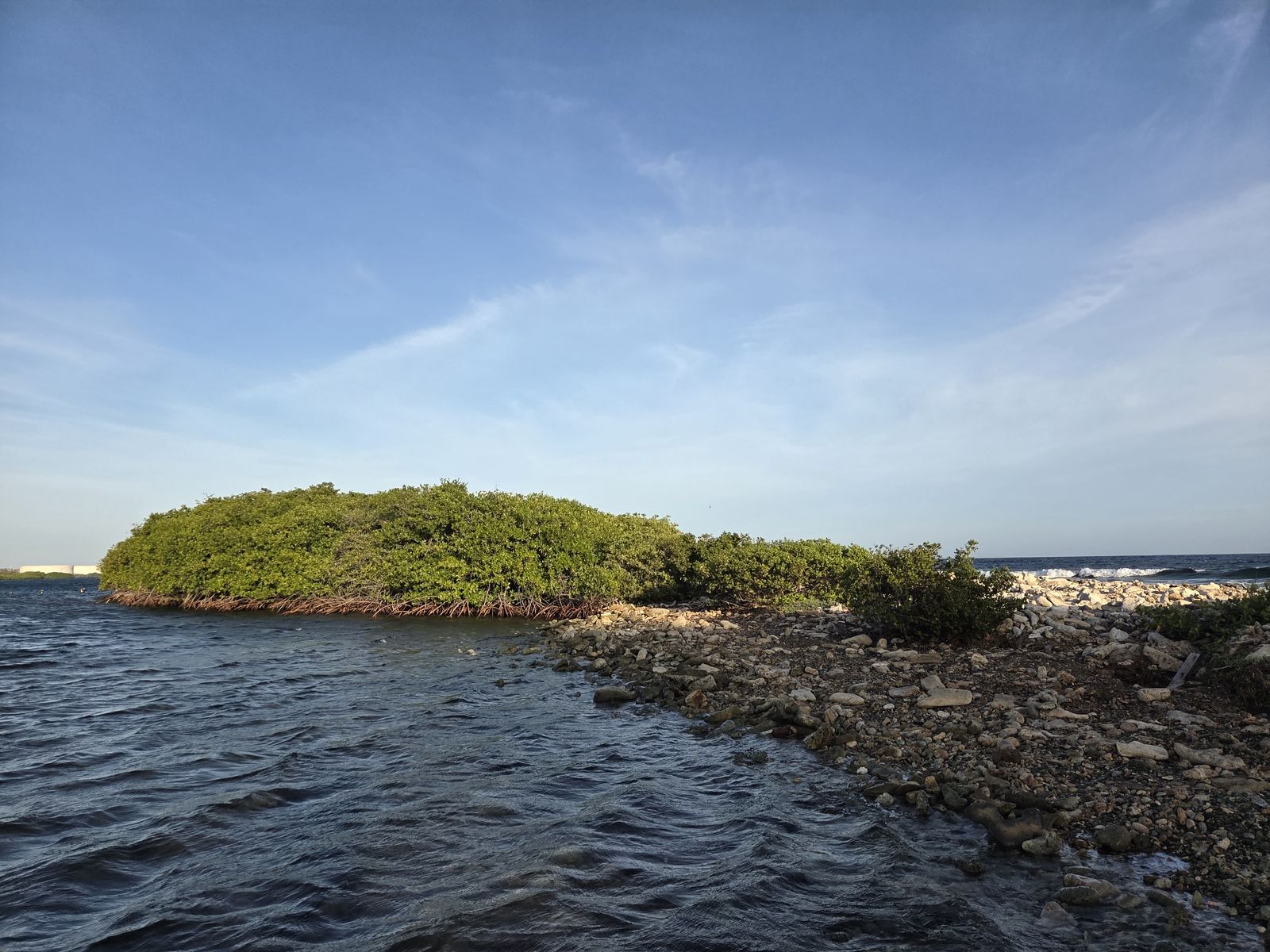
Spanish Lagoon, Aruba: mangrove channels and how to see them
 Your booking is financially protected by Trust My Travel
Aruba is a dry island of cactus, divi divi trees and wind. Then the road drops toward the south coast and you find a green tidal inlet running inland, quiet as a held breath, with mangrove roots standing in the water on both sides. That is Spanish Lagoon, and it is one of the few places on the island where the water is completely still.
What Spanish Lagoon is
Spanish Lagoon, Spaans Lagoen in Dutch, is a tidal inlet on Aruba's south coast, roughly two kilometers long and a few hundred meters wide. Salt water pushes in from the sea, a dry riverbed feeds it from the land, and the meeting of the two grows mangroves: red, black and white mangrove along with buttonwood, on a shoreline of old lava rock and limestone.
Ecologically it is a nursery. The tangle of submerged roots gives young reef fish and crustaceans somewhere to grow up before they move out to the reef, which is a large part of why the snorkeling along this coast is worth doing at all.
It has been listed as a wetland of international importance since 1980, the first site on Aruba to carry that recognition, and the protected area around it was substantially enlarged in 2023. In practice that means you are a guest here: stay in the channels, take nothing, leave nothing.
What you actually see
The lagoon is a birding place more than a beach. Herons and egrets work the shallows. Ospreys pass through. Sandpipers pick along the mudflats, caracaras hold the high branches, and the island's small burrowing owl, the shoco, lives in the dry ground around the inlet. Green parakeets rattle through the trees. Land crabs move at the waterline and dragonflies hang over the still water.
Early morning is when the place performs. The birds are active, the heat has not arrived, and the surface is glass.
How to see it
There is no ticket booth and no boardwalk loop. Two approaches work.
On foot. A walking and birdwatching trail runs from the Pos Chiquito side and takes something like an hour and a half at a gentle pace, passing an old aloe farm and a vantage point over the water. Bring water and go early.
By kayak. This is the way the lagoon was meant to be met. A kayak sits low, moves quietly and fits into channels no boat can enter, so the birds stay where they are instead of leaving. The water inside is sheltered and flat, which makes it forgiving for people who have never paddled.
Paddling the mangroves with us
The mangrove channels of Spanish Lagoon are part of our lagoon and reef route. The kayak and snorkel tour meets at the Mangel Halto beach sign in Pos Chiquito, threads the mangroves, then continues to the reef for two snorkel stops, one at the barrier reef and one at the coral garden.
Tours run daily, 2.5 hours, always a small group. The 8:30 AM departure catches the calmest water of the day. The 1:00 PM departure gives you the strongest light under the water. The 4:30 PM departure turns the return leg into a sunset paddle. Snorkel gear, kayak, water and fruit are included, and guides work in English, Spanish and Papiamento.
The company was founded by a veteran Aruban ranger with decades on Aruba's south coast, and the crew leading your tour learned this water from him, including how to move through mangroves without disturbing what lives in them. Adults pay $89.99 at our summer rate, children from 6 to 12 pay $69.99, minimum age 6. Instant confirmation, free cancellation up to 24 hours before departure, WhatsApp +1 786 971 2221. Check live availability or see all our Aruba kayak tours.
Nearby
The lagoon sits just inland of Mangel Halto Beach, with Savaneta and Zeerovers a few minutes east along the coast road. The island crossing that launches from Savaneta is Sea Glass Island Aruba.
Questions guests ask
Can you kayak in Spanish Lagoon?
Yes. Kayaking the mangrove channels is a long established way to see the lagoon, and the sheltered water inside is calm enough for first timers.
Is Spanish Lagoon protected?
Yes. It has been listed as a wetland of international importance since 1980, and the protected area around it was enlarged in 2023. Treat it as a place to pass through gently.
What wildlife will I see?
Herons and egrets are the reliable ones, along with sandpipers on the mudflats and land crabs at the waterline. Ospreys, caracaras, green parakeets and the small burrowing owl known locally as the shoco are all part of the cast.
When is the best time to go?
Early morning, for bird activity, cool air and flat water. Our lagoon and reef tour includes the mangrove channels on the way out to Mangel Halto.
Choose your adventure
Live availability and instant booking. Pick a date, grab your paddle, and we'll see you on the water.